viernes, 12 de octubre de 2007

No, I Don´t Want to Buy Weavings. Potolo, Bolivia


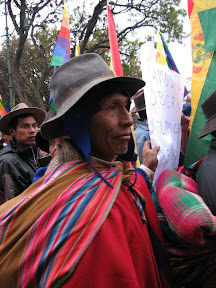
More glorious camion rides later, in the minuscule village of Potolo, I discovered that I´m probably the first gringa ever to arrive there without the intent to stock up on indigenous weaving. I actually think they began to despise me, inviting me into their huts hungrily hoping I would buy buy buy like the slews of foreigners before me. The disappointment was widespread and it turned out to be an awkward day of wandering the same three earthen streets upsetting the population of this adobe oasis left and right with my reluctance to reach for a dollar filled wallet. The hounding demands of "Don´t you want to buy weaving" soon we´re followed by responses from passerbyers "No, she doesn´t want to buy anything". Then I felt, or hopefully imagined, the words behind their stare, "Well then what are you doing in our village gringa?". In disgust of myself, I paid one woman for a photo. After her endless begging for something, this is all I could imagine I wanted from her. Sadly, this was followed by another woman who, overhearing the conversation, insisted to me that she has traditional clothes to...she can go home and change...and then I can pay her for photos as well. Tourism is a wild beast of camera clad power dynamics.

By nightfall, I was sitting at Potolo´s only street stall, trying to eat away the horrible feeling in the pit of my stomach with a plate of fried chicken and mayonnaise. A feeling of otherness, undeserved riches, and sadness for the poverty of the homes I had been invited into. It wasn´t just their poverty, but the fact that "poverty" is far more than complex than simply material and, at the same time, nothing more than relative and perspective, and this relativity takes on a mangled face when their economy is propped up, and their self-worth surely diminished, by weaving-wanting, white tourists. And all of it is really nobody´s fault persay, just the way of things, and this is perhaps the saddest part. So I liberally squeezed out the mayonnaise while Jon Claude Van Dam fought the entire South Pacific in full-volume dubbed Spanish, and village boys gathered around one of the only TVs within hundreds of miles to cheer him on.

Outside Sucre


The Chileno shared my desire to leave Sucre in the throws of its own squables. So we took to the highway once again, with plans to reconvene at our destination; a major intersection in the city outskirts where highways converge and camions sit waiting to carry peasants into the mountainous country-side. Christian had a sizable head start as I waited for the appropriate micro to travel, stop and go, though the streets of urban, third-world chaos. But I passed him on a long stretch of incline, throwing him a peace sign out the window, and we arrived almost at the exact same time. Aboard the first camion we encountered, the scene was pretty much what we expected, the marvel of transportation that could never, EVER exist in our parts of the world. Large, open bed trucks full of everything and anything you could almost ever and never imagine are by far my favorite means of transport. "Do you think they are more strange to us, or us to them" I questioned. A minute´s pondering and a quick analysis of the puzzled stares we were receiving, and I´m pretty convinced they were more interested in the two undeniable outsiders nestling into the hay covered bed of the truck.

We accepted an offer to share in the marry, early-morning drinking of rubbing alcohol with some very inebriated young men. This we immediately regreted, and declined all further insistence, on account that it was akin to drinking acid. So much for trying to fit in with the locals. After a couple hours we unloaded our bags, waved good bye to the drunks and puzzled faces, and began our day of hiking.

We calculated that we walked over 50 km that day, due to being lost and re-found, lost and re-found all the live long day. Such days truly exhaust my Spanish vocabulary. So, between views of 2500 year old rock paintings and a scenic stint down an ancient Incan trail, we succumbed to silence. By 11pm, hungry, incredibly thirsty and exhausted, we finally arrived both at our destination and the realization (always after the fact) that over half of our hike could have been avoided with slightly better map reading skills. Awesome. Anyway, we camped out, ate our fill of camp stove delicacies and I gave the leftover packet of mayonnaise to the exalted virgin statue that lived in the little chapel we were camping behind. Ok, albeit a bit blasphemous, but I maintain that if these Virgins like mayonnaise half as much as the populations that worship them, my gift is going to go over fabulously in the realm of the goddesses.

In the morning, we finally went our separate ways, the last words I heard from Christian were "Siga Viajando!", or "keep traveling" as he waved from his bike, that was surprisingly unharmed after its rough ride with the cargo of the previous days camion ride, and took off back in the direction of Sucre and eventually, someday, Chile.

Sucre Part 1


The Chilano and I split-up in Potosi, him leaving one day before me, with plans of reconvening upon arrival in Sucre. Mid-afternoon the following day, I was on a bus effortless cruising the mountainous terrain by way of combustible engine, when I passed him huffing and puffing, by bicycle, up the highway. I swallowed the urge to make sassy faces at him through the window. We managed to find each other, in a city, Sucre, literally under siege by protest.

So Sucre wants to be capital of Bolivia. Bueno. Actually, more accurately, the citizenry just down right refuses to admit that 100 years ago Sucre lost a civil war that relocated the official federal headquarters to La Paz. With a bullheadedness that I´ve learned is very Bolivian, they just won´t let it die and seem to be willing to pull the entire country into a nation-wide spitting match over the issue.

Basically, its a political mess; a class-war generations old, predicated on the under-education of basically the entire population. To start, Bolivia is proudly presenting the world with one of the only examples of an indigenous president; a president, Evo Morales, who is full blooded Native Indian, figuratively one of the opressed rather than a descendant of Spanish Colonizers. His platform is saturated with promises to elevate the poverty and oppression of Bolivian native peoples and, to achieve this, he has taken his governance on quite a radical path, nationalizing various industries, rewriting the constitution, and becoming strongly aligned with Hugo Chavez of Venezuela. He´s blatantly challenging hundreds of years of history where "rich" and "colonial blooded" have been basically synonymous, and upsetting more than a few prominent people in the process, among them is Sucre´s relatively weathy population.

Logistically speaking, Sucre has basically no reason to be the Capital of Bolivia. With a population of 250,000 it completely lacks infrastructure as a global city; such as sufficient federal buildings, an international airport, or a work force properly educated and trained to make a federal government function. Nor does Bolivia have the money to develop it as one. Yet the entire city is parading through the streets, unified under this cause. So why does everybody continue to be so insistent? I tried diligently to get to the bottom of this conundrum during my visit. I made it a habit of asking everyone, and I mean everyone, to give me valid, political reasoning why the capital should be moved to Sucre. Here´s all I got...

"Because Sucre is the TRUE capital"...

"Because Sucre was the capital FIRST"

"Because democracy was born in Sucre"

"Because Sucre is centrally located in Bolivia"

"Because changing the capital will bring more money and development to Sucre"

Bueno, basically there doesn´t seem to be one reason that carries much political backbone. In the end, its a way for a rich urban populous (Sucre is one of the richest cities in the country) to express their descent for a federal government (Evo Morales) that for once, isn´t putting them first. Its an excuse to take to the streets and to light things on fire in the name of their own pride and anger.

I´m sure without the blockades in the streets, everything from boulders to trucks and buses to flaming tires and brush fires, Sucre is just a charming city. I visited some great museums and even got a tip from one of an indigenous village known for its weaving, in the surrounding mountains. With the arrogance of the protesters heating up and weighing me down, it was time to get out of the city. Don´t get me wrong. I love protest, but only when its fighting to overturn an unjust status quo, not maintain it.