viernes, 12 de octubre de 2007

No, I Don´t Want to Buy Weavings. Potolo, Bolivia


More glorious camion rides later, in the minuscule village of Potolo, I discovered that I´m probably the first gringa ever to arrive there without the intent to stock up on indigenous weaving. I actually think they began to despise me, inviting me into their huts hungrily hoping I would buy buy buy like the slews of foreigners before me. The disappointment was widespread and it turned out to be an awkward day of wandering the same three earthen streets upsetting the population of this adobe oasis left and right with my reluctance to reach for a dollar filled wallet. The hounding demands of "Don´t you want to buy weaving" soon we´re followed by responses from passerbyers "No, she doesn´t want to buy anything". Then I felt, or hopefully imagined, the words behind their stare, "Well then what are you doing in our village gringa?". In disgust of myself, I paid one woman for a photo. After her endless begging for something, this is all I could imagine I wanted from her. Sadly, this was followed by another woman who, overhearing the conversation, insisted to me that she has traditional clothes to...she can go home and change...and then I can pay her for photos as well. Tourism is a wild beast of camera clad power dynamics.

By nightfall, I was sitting at Potolo´s only street stall, trying to eat away the horrible feeling in the pit of my stomach with a plate of fried chicken and mayonnaise. A feeling of otherness, undeserved riches, and sadness for the poverty of the homes I had been invited into. It wasn´t just their poverty, but the fact that "poverty" is far more than complex than simply material and, at the same time, nothing more than relative and perspective, and this relativity takes on a mangled face when their economy is propped up, and their self-worth surely diminished, by weaving-wanting, white tourists. And all of it is really nobody´s fault persay, just the way of things, and this is perhaps the saddest part. So I liberally squeezed out the mayonnaise while Jon Claude Van Dam fought the entire South Pacific in full-volume dubbed Spanish, and village boys gathered around one of the only TVs within hundreds of miles to cheer him on.

Outside Sucre


The Chileno shared my desire to leave Sucre in the throws of its own squables. So we took to the highway once again, with plans to reconvene at our destination; a major intersection in the city outskirts where highways converge and camions sit waiting to carry peasants into the mountainous country-side. Christian had a sizable head start as I waited for the appropriate micro to travel, stop and go, though the streets of urban, third-world chaos. But I passed him on a long stretch of incline, throwing him a peace sign out the window, and we arrived almost at the exact same time. Aboard the first camion we encountered, the scene was pretty much what we expected, the marvel of transportation that could never, EVER exist in our parts of the world. Large, open bed trucks full of everything and anything you could almost ever and never imagine are by far my favorite means of transport. "Do you think they are more strange to us, or us to them" I questioned. A minute´s pondering and a quick analysis of the puzzled stares we were receiving, and I´m pretty convinced they were more interested in the two undeniable outsiders nestling into the hay covered bed of the truck.

We accepted an offer to share in the marry, early-morning drinking of rubbing alcohol with some very inebriated young men. This we immediately regreted, and declined all further insistence, on account that it was akin to drinking acid. So much for trying to fit in with the locals. After a couple hours we unloaded our bags, waved good bye to the drunks and puzzled faces, and began our day of hiking.

We calculated that we walked over 50 km that day, due to being lost and re-found, lost and re-found all the live long day. Such days truly exhaust my Spanish vocabulary. So, between views of 2500 year old rock paintings and a scenic stint down an ancient Incan trail, we succumbed to silence. By 11pm, hungry, incredibly thirsty and exhausted, we finally arrived both at our destination and the realization (always after the fact) that over half of our hike could have been avoided with slightly better map reading skills. Awesome. Anyway, we camped out, ate our fill of camp stove delicacies and I gave the leftover packet of mayonnaise to the exalted virgin statue that lived in the little chapel we were camping behind. Ok, albeit a bit blasphemous, but I maintain that if these Virgins like mayonnaise half as much as the populations that worship them, my gift is going to go over fabulously in the realm of the goddesses.

In the morning, we finally went our separate ways, the last words I heard from Christian were "Siga Viajando!", or "keep traveling" as he waved from his bike, that was surprisingly unharmed after its rough ride with the cargo of the previous days camion ride, and took off back in the direction of Sucre and eventually, someday, Chile.

Sucre Part 1


The Chilano and I split-up in Potosi, him leaving one day before me, with plans of reconvening upon arrival in Sucre. Mid-afternoon the following day, I was on a bus effortless cruising the mountainous terrain by way of combustible engine, when I passed him huffing and puffing, by bicycle, up the highway. I swallowed the urge to make sassy faces at him through the window. We managed to find each other, in a city, Sucre, literally under siege by protest.

So Sucre wants to be capital of Bolivia. Bueno. Actually, more accurately, the citizenry just down right refuses to admit that 100 years ago Sucre lost a civil war that relocated the official federal headquarters to La Paz. With a bullheadedness that I´ve learned is very Bolivian, they just won´t let it die and seem to be willing to pull the entire country into a nation-wide spitting match over the issue.

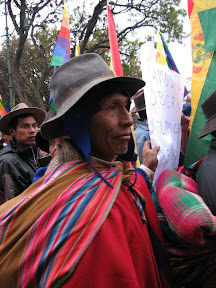
Basically, its a political mess; a class-war generations old, predicated on the under-education of basically the entire population. To start, Bolivia is proudly presenting the world with one of the only examples of an indigenous president; a president, Evo Morales, who is full blooded Native Indian, figuratively one of the opressed rather than a descendant of Spanish Colonizers. His platform is saturated with promises to elevate the poverty and oppression of Bolivian native peoples and, to achieve this, he has taken his governance on quite a radical path, nationalizing various industries, rewriting the constitution, and becoming strongly aligned with Hugo Chavez of Venezuela. He´s blatantly challenging hundreds of years of history where "rich" and "colonial blooded" have been basically synonymous, and upsetting more than a few prominent people in the process, among them is Sucre´s relatively weathy population.

Logistically speaking, Sucre has basically no reason to be the Capital of Bolivia. With a population of 250,000 it completely lacks infrastructure as a global city; such as sufficient federal buildings, an international airport, or a work force properly educated and trained to make a federal government function. Nor does Bolivia have the money to develop it as one. Yet the entire city is parading through the streets, unified under this cause. So why does everybody continue to be so insistent? I tried diligently to get to the bottom of this conundrum during my visit. I made it a habit of asking everyone, and I mean everyone, to give me valid, political reasoning why the capital should be moved to Sucre. Here´s all I got...

"Because Sucre is the TRUE capital"...

"Because Sucre was the capital FIRST"

"Because democracy was born in Sucre"

"Because Sucre is centrally located in Bolivia"

"Because changing the capital will bring more money and development to Sucre"

Bueno, basically there doesn´t seem to be one reason that carries much political backbone. In the end, its a way for a rich urban populous (Sucre is one of the richest cities in the country) to express their descent for a federal government (Evo Morales) that for once, isn´t putting them first. Its an excuse to take to the streets and to light things on fire in the name of their own pride and anger.

I´m sure without the blockades in the streets, everything from boulders to trucks and buses to flaming tires and brush fires, Sucre is just a charming city. I visited some great museums and even got a tip from one of an indigenous village known for its weaving, in the surrounding mountains. With the arrogance of the protesters heating up and weighing me down, it was time to get out of the city. Don´t get me wrong. I love protest, but only when its fighting to overturn an unjust status quo, not maintain it.

jueves, 13 de septiembre de 2007

Potosi, Bolivia


Potosi, Bolivia is perhaps one of the strangest places on earth. And frankly, I´m shocked to have not known anything about it before my visit to Bolivia. In fact, for about one hundred years (about 1560-1660) it was the largest, most prosperous, booming city in the Western Hemisphere provoking a common Bolivian phrase "vale un Potosi" (rich as Potosi). But today Potosi is as poor as it once was prosperous, and, despite huge advancements in mining technology, workers are as exploited as ever. The cerro itself resembles a giant honeycomb, whose open cells bear mute testimony to its gaudy–and tragic–history. With a local economy tied tragically and swinging like an unpredictable pendulum according to global mineral prices, today only a few things are certain. The work is unbearably barbaric, a form or mining with hand tools and man-powered pulley systems that lower the littlest of the men (or often children) into dynamite blasted-out shafts that extends deep into the heart of the mountain. The average miner will last only ten years before contracting a fatal respiratory illness. For the exception of a few recently formed cooperatives for the laborers, its everyman for himself. Thus each man is earning the cash equivalent of what minerals he hauls out of the mountain each day. There are effectively no labor laws or regulations, so, in search of their fortune, in hopes hitting it big, and the chance to never have to wake another morning to return to that mountain, men will work 10, 12, 15, or sometimes 20 hours without rest. They earn between $8-$12 per day and there is absolutely never a lack of labor. Almost all of them are indigenous Indians that have migrated from the countryside; some of the poorest people in the world that live their lives caught in the cracks, in the margins, of our tragic dance of modern development.

Potosi is the "worlds highest city" and at 4000 meters the altitude is really no joke. For me, a flight of steps equates near heart failure. I can´t comprehend the physical exertion of the miners. To cope, the miners have mouths packed with coca leaves (and rotted teeth), literally dripping with the green juices. The leaf of the Coca plant, a source of enormous controversy in between the Bolivian and American governments, is proven to help alleviate altitude sickness, hunger and fatigue and has been used socially, culturally and ritually by Andean people for more that 2500 years. Initially it was outlawed by Spanish colonialist, until they quickly realized the benefit it produced in their enslaved labor force.

Christian, the Chileno, and I arrived at another unknown dark middle-of-the-night, freezing hour. And again I passed countless pitch-black, shivering hours inside the bus, waiting for day break. But if its between this and paying for a room, I´ll take it, chilled bones and all. At day break, we found a room, and set out to see the mines. There are tours. Oodles of tours where they´ll take you up the mountain, give you a silly full body miners suit to wear, boots, helmet and all and after prancing around in your funny new clothes and posing for smiling group shots, "Hey, look at us, we´re real miners" they do explosive demonstrations so you can ooh and aah at the homemade dynamite. Then they´ll take you into the mine to see how the men work and even hand over a shovel or two to let the bravest group members give it a go. The biggest tourist brute will swing the pick or the shovel a few times, grinning while his girlfriend takes photos, and then collapse in high altitude exhaustion. Sorry to sound like a pessimist, but this is just nauseating. We´re talking about one of the gravest workers rights situations in the world, an emblem of global inequality, and a mine that has taken the lives of over 8 million slave laborers (both literal slaves and economic slaves). This is like getting a pretend number "tattooed" on your arm before skipping your way, camera clad, through a concentration camp. I just couldn´t do it. So Christian and I asked for bus directions to the mine and just took ourselves up the mountain to check it out. Finding a way in proved easy as everyone was keen take a few Bolivianos to walk us around their work sites. And hey, better the money goes directly to them, then to some tourist agency called "Gringo Enterprises" in the city. We visited a few sites. Absolutely chilling places where each gaping entryway into the mountain was blackened by the blood of a llama, its bones and skulls littering the ground, left over from a twice annual sacrificial ceremony to keep the miners safe. At one, I was riveted, my feet cemented in place by the impressionable, unforgettable site of one group of young men marching, trance-like, from one of the shafts. There headlamps produced a strange suspended bobbing light against their blackest of black work environment, like orangish glowing stars dancing from the depths of the mountain. And finally they emerged into the daylight, rocks crunching under weathered shoes, with bodies, and presumably lungs too, powdered ghost white by the fine mineral dust of their dynamite explosions.

Un Chico Chileno


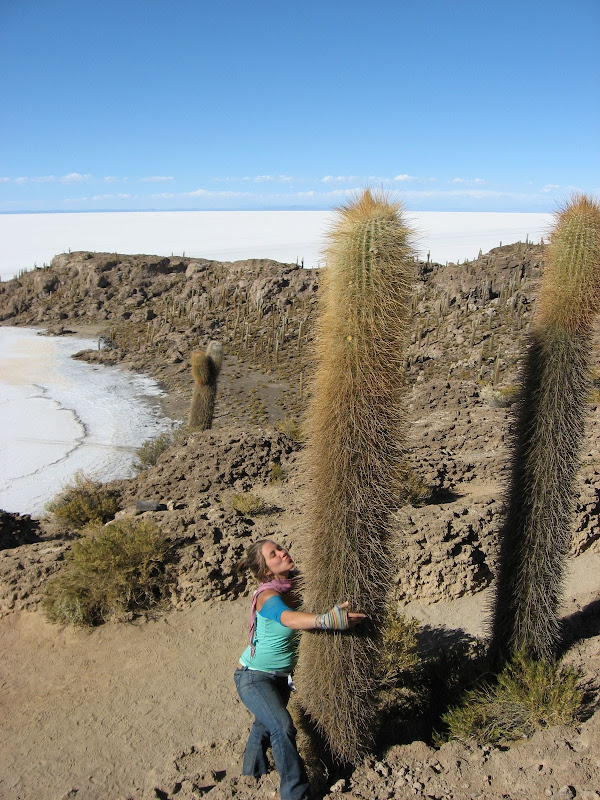
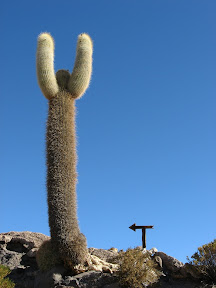
My first encounter with the Chilean was spotting him, hauling booty, across the giant frozen deer lick (if you didn´t grow up in Michigan, maybe it escapes you that this is a referance to a giant block of salt). He was wearing some sunglasses-goggle-things that made him look strikingly like a grasshopper. The carload of us took to hooting and hollaring at him, giving him props for taking on such an expidition by bike. Later we actually met him while our 4x4 stopped off on the "Isla del Pescado", a fish shaped island peppered picturesquly by cacti. We learned he had actually come all the way from Chili, on his bicycle. And then again he and I met, the night the three-day tour concluded, and I was aboard my next overnight bus to Potosi. I´m sitting there waiting for departure and guess who stumbleds aboard, hagarded as ever? Having removed his sun-goggles, it was clear and comical to see that the combination of relentless high-altitude sun, its intensified glare off the blaring white salt flats, and his buggy eyewear had produced serious facial tan lines that made even the worst farmers tan look normal. Now, goggles down, he had an incredibly impressive liking to a racoon. We became instant friends.

Salar de Uyuni


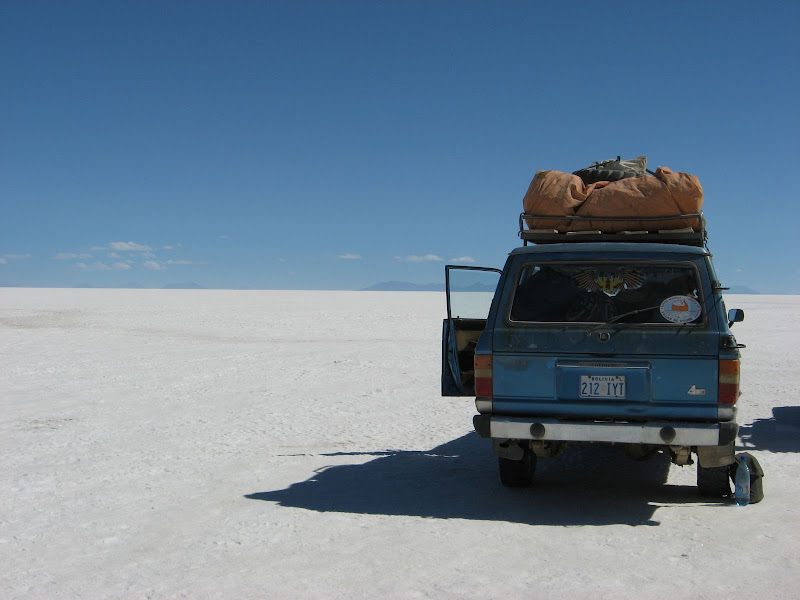
Mom was delyed several days due to a very inconvienant pickpocking incident in the Rodrigez Marketplace of downtown La Paz. But the day she left, I got out of town on the first available bus to the Salar de Uyuni, the worlds largest salt flats. Like Utah, minus the mormons and with a lot more salt. The bus arrived a little earlier than expected (what, am I in Bolivia any more?). And since there is next to nothing one can do when arriving in a new city at 2am, its helpful that in Bolivia it is permitted to sleep in the bus until day break; which I did, shivering in the briskness of the below freezing night. The odd, salty landscape of the Salar is certainly as awe-inspiring as pictures make it out to be. But there´s one thing that pictures can´t convay, the COLD, the very, incredibly, three days of bumping along the desert in an unheated 4x4 and sleeping in equally unheated "hotels" in the middle of the oppressive salt dessert, cold. Not only is it 4:30 am when they hustle you out of bed to be whisked away in the 9-person-packed 4x4 to see various heavily touristed, yet incredible attractions, but its 10 degrees below zero...and we´re talking celsios. And its a good thing the desert doesn´t offer many driving obsticals because our driver, Jose, had only one fuctional eye, the other was either missing or somehow out-of-wack, hidden behind a crazy mess of guaze and medical tape.

miércoles, 5 de septiembre de 2007

Family Time Conclusion Aug 1st-14th


After chasing down monkeys in the forest and eating precariously preserved foods for three days in the Parque National de Madidi, we headed to Copocabana situated gorgeously on the shore of el famoso Lago Titicaka, the worlds highest navigable lake. Copacabana just so happened to be gearing up for its once annual fiesta of the Virgin. Every city seems to have some Catholic Virgin to whom the citizenry attribute scores of miracles. Therefore virginity, though only in women, is very highly regarded. Of course this disparity; virginity in women but not men, is mathematically, absolutely impossible given that it takes two to tango. Thus, the exalted virgin bit is merely a patriarchal sham of organized religion to dominate and control the sexuality of women, if you want to know how I feel about it. Anyway, Copacabana was busy honoring the Virgin by baptizing the hoods of extemely festively decorated cars, buses, taxis and all else motorized with holy wine. Where or how this tradition originated is beyond me but taxistas and bus drivers were arriving in flocks from far flung Bolivian villages to have the Virgin work her magic on their automobiles. Aside from this odd automobile baptism, Bolivians were getting absolutely sloshed in the streets and gorging on the multitude of sweets from the millions of vendors that had set up shop to take advantage of the festival´s crowds. Escaping the furry, we headed via a tourist packed ferry, to Isla del Sol, and arrived there not to long after the advent of electricity. We easily passed two days by hiking ancient Incan terraces and llama watching on this land where, according to dogma, the first two Incan gods (man and wife) rose together out of the lake. Returning to Copacabana, only long enough to catch our onward bus, we were off to Cuzco, the original capital of the Incans and later Repubic of Peru.

Cuzco is an absolutely gorgeous city, chock full of brilliant restaurants, cobblestone streets straight out of your wildest colonial architectural dreams (if you have those), and fabulous fair-trade-option-shopping. We were sure to take advantage, sampling oven roasted Guinea Pig, a national delicacy served roasted, head, little feet, tail and all. We can thank ancient Anden Indians, who were the first to domesticate the Guinea Pig, for our little fury pets today. Machu Picchu was, of course, nothing short of incredible, though unfortunately, Aguas Calientes at its base, is a tourist dump. I happily was able to count on my brother to wake at 4:30am to hike to Machu Picchu, avoiding the slew of tour bus that carry the daily limit of 500 visitors to the top of the mountain. Judging by the dangerously small size of the steps all over the restored archaeological mecca, I´m convinced that Incans had microscopically small feet.

Lastly, I must make comment to our mountain bike trip down the "Worlds Most Dangerous Road". "Our" being only Mom and I...can you imagine Randy (clumsy and absent mind being among the many adj one could use to describe him) embarking on a bicycle ride that involves cliffs and potential death?! We descended about 12,000ft over the course of 42 miles, in about 4 hours. Simply put, the unrivaled feeling of flying by bicycle past a bus full of Bolivians gazing in astonishment out their windows at 40mph is just plain indescribable.